Flintcomb-Ash threshing machine
Tess of the d'UrbervillesThe Flintcomb-Ash threshing machine is a mobile industrial device whose unceasing motion governs the hardest work Tess Durbeyfield performs at Flintcomb-Ash. It is not merely background machinery: the machine dictates the workers’ pace, confines Tess to a particular station, and makes her fatigue physically visible, while Alec d'Urberville watches from the field and resumes his advances. The machine’s harsh efficiency gives material form to the novel’s account of agricultural labor and the vulnerability of women who must endure it.
Appearance and Operation
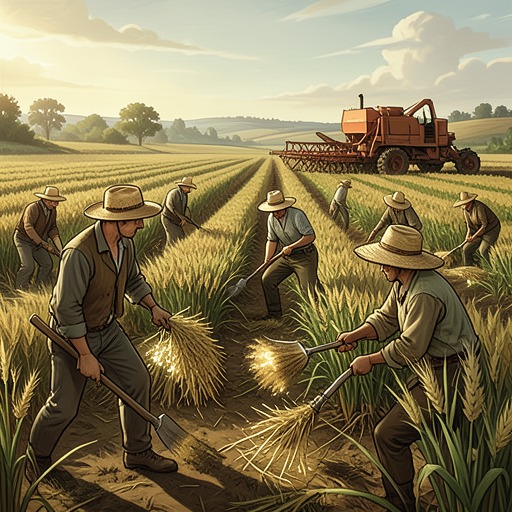
Close under the eaves of the last wheat-rick, the threshing machine appears as a red, timber-framed construction fitted with straps and wheels. A separate engine supplies its power: a long strap connects the engine’s driving wheel to the thresher, and once in motion the drum separates grain from the sheaves. The description makes this link the sole tie between the engine-man and the agricultural world around him; the machine is both a practical apparatus and the conspicuous point where itinerant steam power enters the field.
The threshing day begins before dawn. While the men strip thatch from the rick, the women workers wait in the cold for Farmer Groby’s order to begin. When the stack is uncovered, Tess is stationed on the machine’s platform beside the feeder. Izz Huett passes her sheaves from the rick; Tess unties them quickly enough for the feeder to spread the corn over the revolving drum. Each sheaf is swallowed by the mechanism, which extracts its grain in an instant. The machine makes the division of labor exact: Izz supplies the sheaves, Tess prepares them, and the feeder delivers them to the drum.
The Worker's Place at the Machine
Once the work starts, the machine runs through the morning, pauses for half an hour at breakfast, and then resumes. The workers build a straw-rick beside the diminishing corn stack, eat a hurried lunch without leaving their positions, and continue as the drum spins and its penetrating hum vibrates through the people nearby. The process is not simply strenuous but difficult to interrupt. Because the drum cannot stop without halting the flow of corn, the feeder cannot stop; because Tess must keep supplying him with untied sheaves, she cannot stop either. Marian sometimes takes Tess’s place for half an hour despite Groby’s objection that she is too slow-handed for the feeder’s work.
Groby selects Tess because, in his view, she combines strength, quickness, and endurance. That assessment assigns her apparent physical capacity an immediate economic use: she is placed where the work is most continuous. The women working on the rick can drink ale or cold tea and exchange a few words while clearing husks from their clothes. Tess, beside the machine, has no comparable respite. Its noise prevents conversation, and a shortage of corn makes the hum rise to a roar. At dinner, when the machine finally stops, her knees tremble so badly that she can scarcely walk.
Exhaustion and Alec's Return
The machine’s demands intensify as the last wheat-rick is threshed. Farmer Groby orders the work finished that night because the engine-man is contracted to work on another farm the following day; a moon will allow the labor to continue after dark. As the stack shrinks, Tess becomes more isolated on the platform. The distance from her fellow workers prevents Marian and Izz from changing places with her as before, while the machine’s constant vibration leaves Tess in a stupefied reverie: her arms keep working almost independently of her awareness, and she can barely hear Izz call up to tell her that her hair is falling loose.
Alec d'Urberville appears while Tess is absorbed in the work. She cannot turn her head freely from the machine, but knows that he is watching her. As the afternoon passes, he waves and blows her a kiss, a gesture he takes to signify that their quarrel is over. Farmer Groby later offers to replace Tess so that she can join her visitor. She understands that this accommodation comes at Alec’s request, refuses it with a shake of the head, and continues working. The machine thus becomes the fixed point around which her refusal and Alec’s renewed approach play out: he can watch and wait, but she remains at her post.
By evening, the diminishing rick has left Tess still more exposed to the machine’s movement. Her face and bonnet are coated with corndust, and the incessant shaking has exhausted her so completely that she works in a daze. The final sheaf is not reached until the rat-catching begins at the base of the stack. Amid barking dogs, shouting, screams, and confusion, Tess unties it; the drum slows and the whizzing stops. Only then does she step down to the ground. Alec, who has watched the rat-catching, is immediately beside her. The end of the machine’s labor does not end his pursuit; it provides the moment when he can approach her directly.
Agricultural Change and Narrative Significance
The scene places the thresher amid a conflict between older and newer forms of farm labor. The old men on the straw-rick recall threshing with flails on the oaken barn floor, when even winnowing was done by hand. They remember the slower work as producing better results. Against that memory stands the machine’s speed and unbroken rhythm, which efficiently consumes the sheaves but subjects the workers near its moving drum to relentless exertion. It represents agricultural change not as an abstract improvement but as a force reorganizing labor, time, and physical endurance.
The machine also shapes what can be perceived and communicated. Its hum overwhelms speech; Tess cannot hear Izz’s inquiry from below, and she cannot freely turn to see who is watching. The workers’ differing positions matter: those on the rick can pause or exchange words, while Tess’s assigned task ties her to the feeding process. In this way, the device is not simply a neutral tool that people use. Its operation makes certain kinds of work and vulnerability unavoidable in the scene, while the employer’s choice of Tess for her staying power places the consequences on her body.
The threshing machine is therefore the scene’s organizing object as well as its instrument of production. It draws the workers into a hierarchy of tasks, stretches their labor from dawn into the evening, and reduces Tess’s capacity to notice or respond as she works. Its stop marks a decisive transition: the last sheaf has been processed, Tess can leave the platform, and Alec can move from watching to confronting her. The machine’s mechanical rhythm and its abrupt cessation give the episode its structure, binding the pressure of modern farm work to the personal danger that waits just beyond the task.